
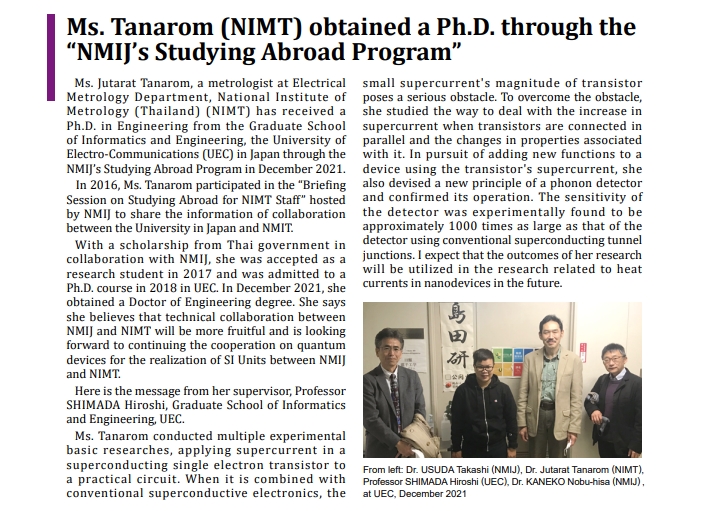
NIMT metrologist Jutarat Tanarom obtains a Ph.D. through the “NMIJ’s Studying Abroad Program” (NMIJ Newsletter No.15, May 2022)

Congratulations to Dr.Jutarat Tanarom on the occasion of receiving a Ph.D. in Engineering from the Graduate School of Informatics and Engineering, the University of Electro-Communications (UEC). This program has shown already closely heart-to-heart cooperation between NIMT and NMIJ. Here is an article on NMIJ Newsletter No. 15, May 2022. For more reading, visit https://unit.aist.go.jp/qualmanmet/nmijico/en/Newsletter/NMIJ_Newsletter_2022_No15.pdf

“Ms. Jutarat Tanarom, a metrologist at Electrical Metrology Department, National Institute of Metrology (Thailand) (NIMT) has received a Ph.D. in Engineering from the Graduate School of Informatics and Engineering, the University of Electro-Communications (UEC) in Japan through the NMIl’s Studying Abroad Program in December 2021. In 2016, Ms.Tanarom participated in the “Briefing Session on Studying Abroad for NIMT Staff” hosted by NMI] to share the information of collaboration between the University in Japan and NMIT. With a scholarship from Thai government in collaboration with NMI|, she was accepted as a research student in 2017 and was admitted to a Ph.D. course in 2018 in UEC. In December 2021, she obtained a Doctor of Engineering degree. She says she believes that technical collaboration between NMI] and NIMT will be more fruitful and is looking forward to continuing the cooperation on quantum devices for the realization of SI Units between NMI and NIMT. Here is the message from her supervisor, Professor SHIMADA Hiroshi, Graduate School of Informatics and Engineering. UEC. Ms.Tanarom conducted multiple experimental basic researches, applying supercurrent in a superconducting single electron transistor to a practical circuit. When it is combined with conventional superconductive electronics, the small supercurrent’s magnitude of transistor poses a serious obstacle. To overcome the obstacle, she studied the way to deal with the increase in supercurrent when transistors are connected in parallel and the changes in properties associated with it. In pursuit of adding new functions to a device using the transistor’s supercurrent, she also devised a new principle of a phonon detector and confirmed its operation. The sensitivity of the detector was experimentally found to be approximately 1000 times as large as that of the detector using conventional superconducting tunnel junctions. I expect that the outcomes of her research will be utilized in the research related to heat currents in nanodevices in the future.”


Information update: Natthaphon Jarat and Thanakporn Nontachart, International Relations Officer.
Facebook: https://www.facebook.com/NIMT2541/
YouTube: https://www.youtube.com/user/nimt2541
Flag Counter

Thailand Standard Time on an accurate digital network

The expansion of Digital Society, Internet, e-Commerce or even Metaverse that we have only recently heard about.  It has been  working tally with Thailand Standard Time (TST). Hence, TST has to be built on a digital network to aggregate the various activities of humans, computers, robots, and AI algorithms to go hand in hand. Currently, the standard time system on digital networks has evolved to the 3rd generation with low error.


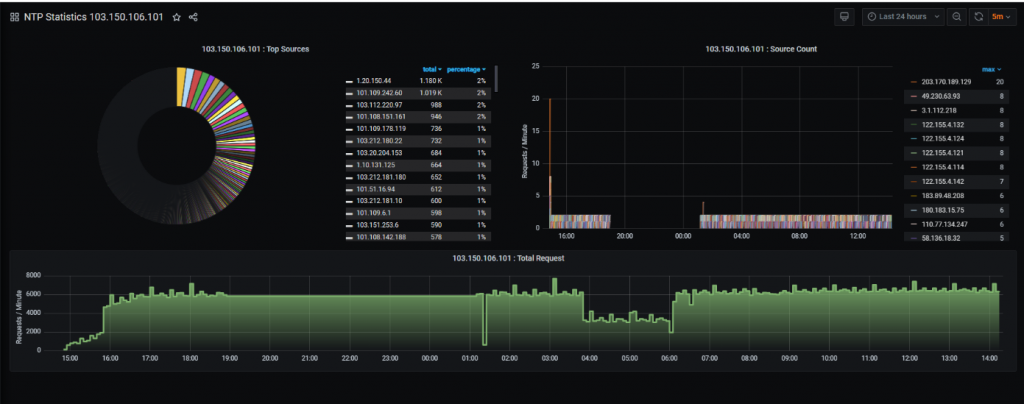
In detail, the 1st Generation has an error of milliseconds (thousandths of a second). The 2nd Generation has a microsecond (millionth of a second) error and the 3rd Generation, the latest development, has an error as low as nanoseconds (a billionth of a second). It is dispersed in all fields such as radar, military, aviation, high-speed rail, banking, communications, 5G network, and even money transfers. Since establishing the NIMT National Time Protocol (NTP) in 2005, it has been accessed increasingly. From the beginning of NTP service, NIMT has only 2 devices to support the whole country requirement. Afterwards,  NIMT was able to provide 3 and 4 devices accordingly. The existing devices could be ripe for whole capabilities that time. Until 2020, the demand for NTP calibrating has reached 120 million times per day. Those devices may not be adequate to be ready for service. Therefore, NIMT has developed the Standard Time for Digital Infrastructure of Thailand to create a standard for the country’s digital system. It supports the global digital transformation under the standardization support.

It was generally known that NIMT has built and established a standard time system on a digital network for over 20 years. From a little point, from the microsecond era to the nanosecond era, now NIMT has a large Time Infrastructure to make Thailand stable and has the potential to compete as a rival in a digital world that keeps evolving from the past to the future tangibly.

On April 1, 2022, the standard time infrastructure for high-performance digital networks to 200,000 transactions per second was activated for the first time in Thailand. Then, NIMT established a high-performance standard time transmission system via the Internet to serve as an infrastructure to support the users of standard time on the digital network of Thailand.  It is sufficient and sustainable to meet the needs of all sectors. Currently, the TST  for Digital Infrastructure has 5 channels as follows;

time1.nimt.or.th
time2.nimt.or.th
time3.nimt.or.th
time4.nimt.or.th
time5.nimt.or.th

Please see more detail this link https://www.nimt.or.th/main/?page_id=15520


Information update: Natthaphon Jarat and Thanakporn Nontachart, International Relations Officer, and Ms.Tusita Songkit, International Relations CO-OP working student.
Facebook: https://www.facebook.com/NIMT2541/
YouTube: https://www.youtube.com/user/nimt2541
Flag Counter